

One-way draw
Stacks toward the side that best clears the active door panel or preserves the view.
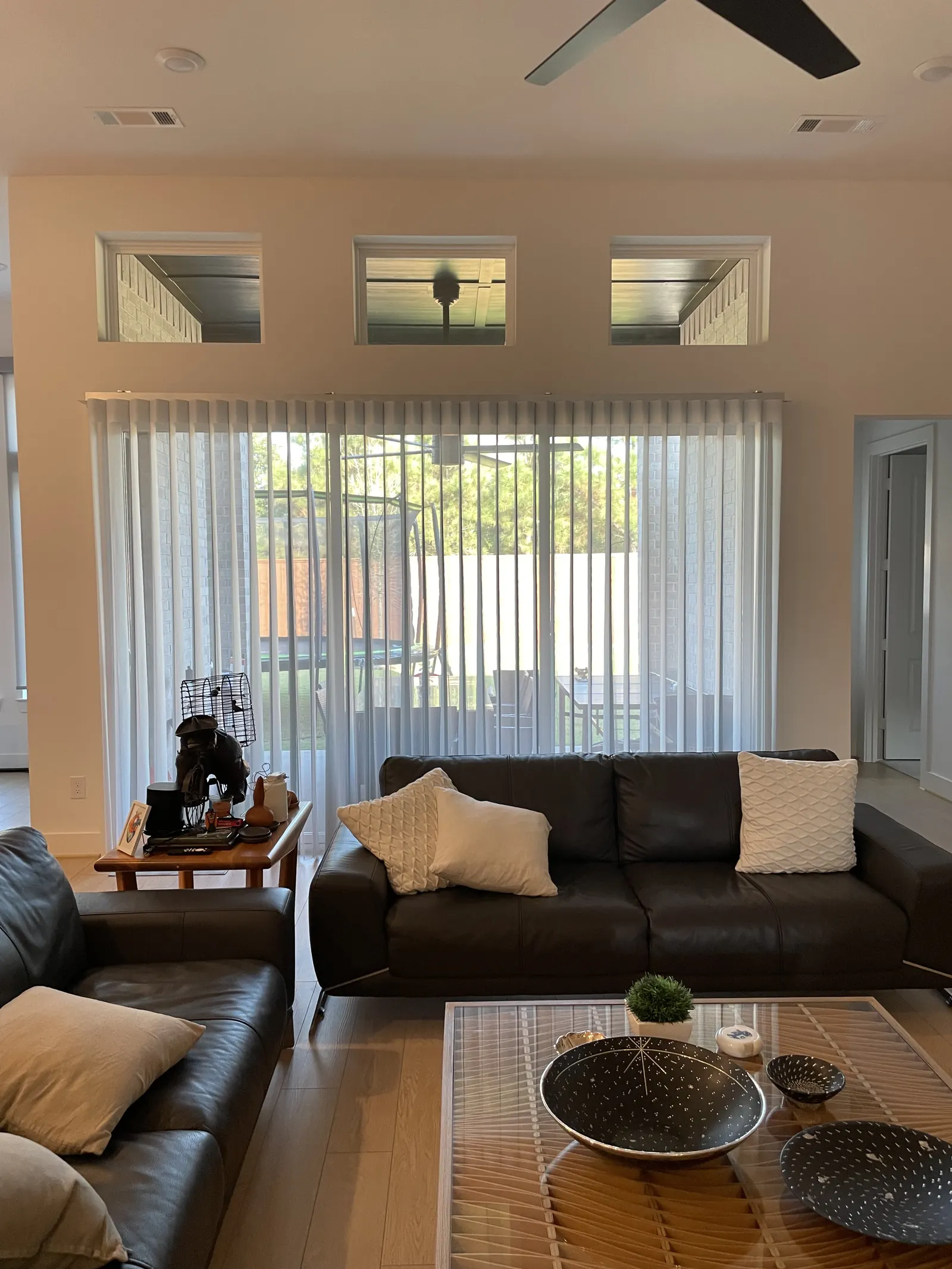
Traditional vertical blinds—and a softer modern alternative
Two side-stacking solutions for sliding doors and oversized windows: traditional vertical blinds for straightforward function, and Norman SmartDrape for a softer, drapery-like finish.
Vertical blinds solve a specific, practical problem—covering a sliding door or an oversized window with a treatment that moves in the same direction as the door.
SmartDrape is not a conventional vertical blind and it is not ordinary drapery. Its individual fabric vanes rotate for light and privacy, stack laterally, and can be walked through without moving the entire shade out of the way. That makes it especially useful where indoor-outdoor traffic matters but a room needs a softer finish than rigid vanes.
The Starlite project shown above uses SmartDrape across a broad glazed opening. We bring the actual material options to the home so you can compare how the fabric hangs, filters light, and relates to the furniture before choosing it over a traditional vertical blind.
Start with how the door moves
Door direction, handle clearance, furniture, finish, and the preferred parking side all affect the layout.
Stacks toward the side that best clears the active door panel or preserves the view.
Divides the stack when symmetry or access from the middle suits the opening better.
Rigid vertical vanes are practical and wipeable; SmartDrape uses individual soft fabric vanes for a more drapery-like room.
Matched to the project
These are different products, not price tiers. We compare how each one moves, looks, cleans, and fits the opening.

Traditional vertical blinds, vertical sheers, and panel-track options for sliding doors and broad windows.

SmartDrape combines individual soft fabric vanes, adjustable light control, and walk-through access.
We define what the opening needs first, then choose the brand and system that solve it best.
The most common use case — a horizontal blind simply doesn't work well on a door people walk through.
Vertical vanes handle width better than most horizontal shade styles.
The material changes cleaning, movement, softness, and privacy; we compare full samples at the door.
We bring physical sample books so you can compare color, weave, and openness during the in-home demonstration.
Straight answers
Their strongest advantage is side-to-side movement across broad glass; the right system depends on the room.
Plan your quote
Product family, track width, vane material, stack layout, and controls determine the quote.
We map the active door panel and furniture before ordering so the stack lands in the useful place.
Good to know
That's the most common use, but they also work well on any unusually wide window where a horizontal shade would be impractical.
Motorized control is available for compatible systems, including Norman SmartDrape. The exact functions and controls depend on the product selected.
Usually toward the fixed side of a sliding door, but room layout and furniture can change that. We map the path before specifying the track.
Closed, overlapping vanes provide strong privacy. Small gaps can remain if vanes are disturbed or viewed at an angle, so they are not a sealed blackout product.
They need gentler spot cleaning than rigid vanes. PVC or composite is the better choice when frequent wipe-downs matter.
Basic builder-grade versions can feel dated, but they still solve some sliding doors efficiently. Better traditional materials can look cleaner, while SmartDrape offers a softer, more current alternative when the room calls for it.
No. SmartDrape is Norman's vertical shade with individual soft fabric vanes and walk-through access. We show it here because it solves many of the same wide-door problems, but we compare it as a distinct product.
Measured at home · Recommended honestly · Installed by Starlite
Compare materials, slat sizes, and finishes at home so the practical choice also looks right. Free in-home consultation with real samples—no pressure either way.